jueves, 31 de enero de 2008

Para que no nos perdamos (mes 8)... / Wo wir nach acht Monaten zu finden sind

Hoy, 1 de febrero, cumplimos ocho meses de viaje, y estamos de carnaval en La Paz, preparandonos para continuar hacia el Titicaca y la tierra peruana. Como pasamos no hace mucho por Salta, la capital del folclor andino en Argentina, queremos citar a uno de los grandes de este genero, Atahualpa Yupanqui (o Atahualpa You Funky, como le llama cariñosamente el argentino Kevin Johansen en su ultimo disco), con esta sentencia suya apropiada para viajeros y que encontramos en las paredes de una de las peñas que visitamos:
“Para el que mira sin ver, la Tierra es tierra no mas”.
.......................................................................

Heute, 1. Februar, sind wir schon seit acht Monaten unterwegs und sind gerade in La Paz in Bolivien auf 3600m angekommen, um in Kuerze weiter zum Titicacasee und anschliessend Peru zu reisen. Da wir vor nicht allzu langer Zeit in Salta, der Hauptstadt des andinischen Folkore in Argentinien, waren, moechten wir ein Sprichwort von Atahualpa Yupanqui zitieren (einer der groessten argentinischen Folkoresaenger, dem Kevin Johansen auf seinem letzten Album das Lied „Atahualpa You Funky“ widmet):
„Fuer den der schaut ohne zu sehen, ist die Erde nur ein Haufen Erde“. (naja, das Wortspiel funktioniert auf Spanisch besser...)
.........................................................................

Today, first of February, it’s already eight months we are on the road and just reached La Paz in Bolivia at 3600 m, from where we will continue shortly to the Titicaca Lake and then Peru. As we passed through Salta not long ago, the Argentinian capital of Andean folklore, we would like to quote a saying of Atahualpa Yupanqui, one of the big Argentinian folk singers. Kevin Johansen also dedicated him a song on his last album called Atahualpa You Funky:
“For who looks without seeing, the Earth is only a lot of earth.” (the second “earth” in the sense of soil... it works better in Spanish)


Tambien, y dado que llevamos en el blog un retraso de varios meses con respecto a nuestra ruta actual, hemos querido hacer un pequeño resumen de nuestro ultimo mes, que ha sido prodigo en encuentros y lugares maravillosos (en el blog ya hemos cerrado Camboya, asi que vendran luego una entrada para Bangkok y otra para Sydney, y luego las relacionadas con Nueva Zelanda, Chile, Argentina, Paraguay... uff!) / Nachdem wir mit dem Blog ein paar Monate hinterher haengen, wollen wir kurz unseren letzten Monat zusammenfassen, der voll von wunderbaren Begegnungen und Plaetzen war / As we have several months delay with our blog, we would like to resume in short our last month, that has been full of being together with marvellous people and discovering incredible places.


En los dias de Navidad visitamos a nuestra amiga Cristina en San Juan (Argentina), para celebrar con ella esa fiesta y su cumpleaños el dia anterior. En la imagen esta ella junto a Silke, y aparecen tambien Luciano y Maria Elisa, viejos conocidos de Barcelona que volvieron a Argentina hace varios años / Nachdem wir in Chile von Santiago gen Sueden und in Argentinien vom Sueden wieder gen Norden gereist sind, verbrachten wir Weihnachten mit unserer Freundin Cristina in San Juan (Argentinien) und feierten auch ihren Geburtstag. Cristina steht hier im Bild neben mir. Zur Rechten tauchen auch alte Bekannte aus Barcelona auf, Luciano und Maria Elisa, die seit mehreren Jahren wieder zurueck in San Juan sind. / After travelling in Chile from Santiago towards the South and in Argentina from the absolute South to the North, we reached San Juan in Argentina around Christmas, where we visited our friend Cristina. We moreover celebrated as well her birthday, to be seen in the picture. Cristina stands next to me and on the other side, Luciano and MariaElisa, old friends from Barcelona, who returned as well many years ago.


Luego visitamos en Cordoba (Argentina) a nuestra amiga Isabelle, y celebramos con ella tambien su cumpleaños (el 30 de diciembre) y la nochevieja. En la imagen las dos estan rodeadas por una bufanda que le llego a la Isa desde Camboya... / Danach besuchten wir unsere Freundin Isabelle in Cordoba (Argentinien), und feierten ebenfalls ihren Geburtstag und anschliessend Sylvester. / Afterwards we visited our friend Isabelle in Cordoba in Argentina and celebrated as well her birthday and a day later New Years Eve.


En Buenos Aires nos encontramos con Gaby (a la izquierda) y Mariana, compañeras de un curso de posgrado que hice en Barcelona hace algunos años. Gaby es porteña y alli vive actualmente, y Mariana es mexicana y vive en el DF, pero estaba de vacaciones en Buenos Aires porque su compañero es de alli. Fue un reencuentro especial porque no las veia desde cuando hicimos el curso! / In Buenos Aires trafen wir u.a. Gaby (links) und Mariana, die mit Ricardo zusammen vor ein paar Jahren in Barcelona einen Postgraduate Kurs machten und die er seitdem nicht wieder getroffen hatte. Gaby lebt in Buenos Aires und Mariana in Mexico DF, war aber gerade in Buenos Aires im Urlaub, da ihr Partner dorther stammt. / In Buenos Aires we met Gaby (left) and Mariana, who did a post graduate course with Ricardo a few years ago in Barcelona and he hadn’t seen them since then. Gaby lives in Buenos Aires and Mariana in Mexico DF, but was just in Buenos Aires on holiday, because her partner is from there.


Tambien en Buenos Aires nos reencontramos con Juan y Maria, amigos de varios años en Barcelona (a Juan lo conozco desde la universidad en Bogota). Una feliz coincidencia hizo que nosotros llegaramos a Buenos Aires justo el dia en que ellos llegaban para instalarse en la capital federal despues de dejar atras su vida en España / Ausserdem trafen wir in Buenos Aires Juan und Maria wieder, gute Freunde aus Barcelona. Ein gluecklicher Zufall wollte es, dass sie am gleichen Tag in Buenos Aires ankamen, um dort zu leben, wie wir. / Moreover we met in Buenos Aires Juan and Maria again, good friends from Barcelona. A lucky coincidence resulted in that they arrived the same day in Buenos Aires to live there than us.


Despues de darle vueltas al asunto, decidimos ir a las cataratas de Iguazu, y vaya si valio la pena! Es un espectaculo unico, maravilloso! En la imagen se ven apenas un par de los mas de veinte saltos que conforman ese portento de la naturaleza / Nachdem wir hin und her ueberlegten, entschieden wir uns doch zu den Wasserfaellen von Iguazu zu reisen, was sich auch absolut gelohnt hatte! Im Bild sieht man nur ein paar der ueber zwanzig Wasserfaelle, die ein unglaubliches Naturschauspiel darstellen. / After thinking it over and over, we finally decided to travel to the Iguazu falls and were so happy in the end we did! The waterfalls in the image are just some of the more than 20 in the area and all form an amazing natural spectacle.


Para ir de las cataratas hacia el noroeste argentino, atravesamos por Paraguay y saludamos a Olga y Roland en Colonia Independencia, justo a mitad de camino entre Ciudad del Este y Asuncion, y donde pasamos unos pocos dias de fantastico descanso. Olga es una vieja amiga de la mama de Silke, y ellos llegaron a Paraguay hace unos seis años a buscarse la vida / Auf dem Weg von Iguazu zum Nordwesten Argentiniens reisten wir durch Paraguay und verbrachten ein paar wunderbar erholsame Tage bei Olga und Roland in Colonia Independencia, einer deutschen Kolonie. Olga ist eine gute Freundin meiner Mutter, die ich damit auch endlich kennenlernte. / On the way from Iguazu to the Northwest of Argentina we travelled through Paraguay to pass a few wonderful and relaxing days with Olga, a good friend of my mother, and Roland in Colonia Independencia, a German colony.


Nos reencontramos con Isabelle y su compañero Ricardo en Tucuman, para viajar juntos por el noroeste argentino hasta la frontera boliviana. Fueron dias de paisajes alucinantes y pequeños pueblos con mucho encanto, y hacer la ruta con ellos fue un placer! / In Tucuman trafen wir wieder Isabelle und ihren Partner Ricardo, um mit Ihnen von dort aus durch den Nordwesten Argentiniens bis zur bolivianischen Grenze zu reisen. In den Tagen sahen wir unglaubliche Landschaften, schoene Doerfer mit Ambiente und hatten eine tolle Zeit. / In Tucuman we met again Isabelle and her partner Ricardo, to travel together with them through the Northwest of Argentina up to the Bolivian frontier. We saw incredible landscapes, beautiful villages with a special atmosphere and had a great time.


Entramos en Bolivia e hicimos un viaje por el Salar de Uyuni y las lagunas altiplanicas, tres dias de aislamiento y de paisajes magicos, una excursion que todavia tiene mucho de aventura a mas de 3500 m de altura. En la imagen, una vista del salar, inundado por las fuertes lluvias del verano altiplanico / Dann reisten wir nach Bolivien und begannen dort eine dreitaegige Tour durch den Salzsee von Uyuni und an Gebirgslagunen in allen moeglichen Farben vorbei. Magische Landschaften auf ueber 3500 Meter Hoehe. Die bolivianische Regenszeit machte den Ausflug etwas abenteuerlich und sorgte dafuer dass der Salzsee um diese Zeit Wasser traegt. / Then we travelled to Bolivia and started there the three day tour through the salt flats of Uyuni and lagoons in all colours, all at more than 3500 metres altitude. As it is rainy season in Bolivia right now the saltflats were full ofwater and it made the excursion a bit more adventurous.


Escogimos terminar la excursion en San Pedro de Atacama, un pueblito encantador en el norte chileno, cerca de la frontera con Bolivia. Alli habiamos quedado de encontrarnos con Maria Jose y Domingo, amigos de Barcelona que pasaban sus vacaciones en Chile por estos dias (ella es chilena). Celebramos juntos el cumpleaños de Silke el 26 de enero, dia en que llegamos a San Pedro / Die Tour beendeten wir in San Pedro de Atacama, ein gemuetliches schoenes Doerfchen im Norden Chiles, nahe der bolivianischen Grenze, denn dort trafen wir uns mit Maria Jose und Domingo, gute Freunde aus Barcelona, die gerade in Chile Urlaub machten (Maria Jose ist Chilenin). In San Pedro kamen wir an meinem Geburtstag an und feierten ihn zusammen mit den beiden. Schoener haette es nicht sein koennen. / We finished the tour of Uyuni in San Pedro de Atacama, a cozy nice village in the North of Chile, near the border to Bolivia, because there we met with Maria Jose and Domingo, very good friends of Barcelona, who just spend their holidays in Chile (Maria Jose is from Chile). We arrived there on my birthday and celebrated it together with the two, just perfect!

martes, 29 de enero de 2008

Phnom Penh y el sur de Camboya / Phnom Penh und der Sueden Kambodschas


No es que nos hayamos dedicado, entre otras cosas, a sofisticados tratamientos de belleza, es solo que en Phnom Penh aprovechamos para ir, por primera vez en el viaje, a que nos cortaran el pelo. Y resulta que el corte incluia masaje continuo (una chica para cada extremidad del cuerpo y otra para la espalda) y ademas, una refrescante mascarilla de pepino! El corte lo hizo la dueña de la peluqueria, una mujer muy segura de lo que estaba haciendo (no hay que perderse en el webalbum el peinado que le hizo a Silke). Pasamos de nuevo unos dias estupendos en casa de Christine y Francis, y para quienes pasen por esta ciudad recomendamos un restaurante indio llamado “Shiva Shakti“ (pocos indios como ese) y para desayunar un lugar relajado y con cosas riquisimas llamado ”The Shop“ / Das ist nicht etwa eine Schoenheitssession... nein, das gehoert beim Friseur mit dazu: waehrend sie mir die Haare wuschen, bekam ich eine Maske aus Gurken aufgelegt und zwei bis vier Maedchen massierten mir die Extremitaeten! Den Schnitt verpasste mir dann die Chefin sowie die Foenfrisur. Das Ergebnis der Aktion ist im Webalbum zu bewundern. Wir verbrachten wieder schoene Tage in Phnom Penh mit Christine und Francis. Fuer diejenigen, die nach Phnom Penh reisen werden, koennen wir „the shop“fuers Fruehstueck und ein tolles indisches Restaurant Shiva Shakti empfehlen / This is not a beauty session... no, this is part of going to the hair cutter: meanwhile they washed my hair, they applied the cucumber mask and two to four girls were continuously massaging arms or legs. The cut was executed by the big chief (a very resolute woman) as well as the styling. The elegant result can be admired in the webalbum! We passed again wonderful days in Phnom Penh with Christine and Francis. For those travelling to Phnom Penh we heartily recommend an Indian restaurant “Shiva Shakti” and for breakfast a relaxing place called “The Shop”.


Iniciamos el viaje hacia el sur de Camboya dirigiendonos de Phnom Penh a Kampot, que esta a un paso de la costa. Pero sobre la marcha decidimos bajarnos un poco antes, en el pueblo costero de Kep. Valio la pena, por fortuna. Estas gambas con pimienta fresca de la zona en el Kimleys (en el mercado de cangrejo, que es la especialidad de la zona y que tambien pedimos, como se puede ver en el webalbum) estaban de maravilla! Teniamos ademas una estupenda vista al mar desde este sencillo restaurante. Kep es un lugar extraño, pues parece un pueblo fantasma, dada la gran cantidad de villas abandonadas desde los tiempos del regimen de Pol Pot. Hace menos de un año que llego la electricidad al pueblo, y parece que rapidamente cambiara este abandono, gracias a su ubicacion privilegiada / Eigentlich wollten wir von Phnom Penh direkt nach Kampot reisen. Aber als wir in Kep einfuhren, packte uns auf einmal die grosse Neugierde und wir stiegen spontan aus, was haben wir auch nicht bereut. Diese Krabben mit frischem Pfeffer bei Kimley im crab market waren einfach himmlisch. Noch dazu sassen wir in einem einfachen Restaurant mit Blick aufs Meer. Nur ueberraschte uns ein heftiger Monsunregen, der durch jede Ritze eindrang, obwohl das Restaurant alles zuklappte. Kep ist ansonsten ein merkwuerdiger Ort mit immer noch vielen verlassenen Villen am Meer von vorm Buergerkrieg, der aber gerade einen Wiederaufschwung erlebt mit Strom seit kurzem und astronomischen Grundstueckspreisen fuer kambodschanische Verhaeltnisse / Actually we planned to travel directly from Phnom Penh to Kampot. But when we entered the beach town Kep, we suddenly felt a big curiosity and decided spontaneously to stay for a day, what we didn’t regret. These prawns with fresh pepper at Kimleys at the crab market are just delicious. Moreover we had a view on the sea from this simple restaurant. Kep is otherwise a strange town with still many abandoned villas next to the beach from before the Pol Pot years. Just recently it starts to live a boom, with real estate prices going astronomically up for Cambodian relations.


Fuimos a Kampot para hacer desde alli la excursion a Bokor Hill Station, un lugar muy particular. En la decada de 1920 los franceses construyeron en esas montañas villas de descanso para huir del calor de las tierras bajas durante el verano, que llegaron a constituir todo un pueblo. Cuando empezo el regimen de Pol Pot la zona fue abandonada, y muchos combates con los Khmer rouge tuvieron lugar alli. En la imagen se puede ver la iglesia catolica en medio de la niebla que aparece y desaparece en esas montañas misteriosas (en el webalbum hay fotos de la ruta, el bosque y el casino abandonado en la cima de una montaña) / Von Kampot aus machten wir einen Tagesausflug zur heute verlassenenen Bokor Hill Station. In den 20er Jahren hatten die Franzosen sich Villen auf dem Berg gebaut, um etwas Kuehle zu geniessen. Es wurde eine ganze Stadt, die seit Anfang des Pol Pot Regimes verlassen ist und wo sogar Kaempfe mit den Khmer rouge bis spaet in die 90er stattfanden. Das neblige Wetter verhinderte zwar eine Sicht aufs Tal, passte aber ganz gut zum Schauplatz / Fromout Kampot we undertook a day excursion to the today abandoned Bokor Hill Station. In the 20ies the French built their villas on top of the mountain to savour some cool air and it got a whole town. When the Pol Pot regime started, the town was abandoned and even many fights with Khmer rouge took place there. The misty weather stole the view on the valley below, but was otherwise quite adequate for the atmosphere of this curious place.


A Bokor Hill Station subimos en bancos dispuestos a lo largo de la parte de atras de una pick-up, donde nos acomodamos nosotros dos y cuatro chicos gringos. La ruta, en pesimo estado, serpentea a traves de una selva magnifica que cae sobre el camino de manera inmisericorde. Teniamos que ir pendientes de esquivar las ramas o lianas bajas, pero lo peor eran las ramas espinosas de ciertas enredaderas que eran realmente peligrosas. Como se puede ver en la imagen, Silke recibio un par de rasguños en la nariz... / Rauf auf den Berg fuhren wir zusammen mit vier jungen Amerikanern auf zwei aneinandergeschraubten Baenken hinten auf einem Jeep. Der Weg ist mittlerweile total zerstoert und der Dschungel waechst kontinuerlich ueber den Weg. Daher mussten wir immer nach vorne schauen, um vorauszusehen, wann wir uns vor Zweigen ducken mussten. Aber einen Ast mit Dornen sah ich zu spaet... Auf dem Foto ist meine Nase schon verarztet und wir schauen uns die Ruinen im Nebel an / We drove on top of the hill on a bank on the back of a jeep together with four young Americans. The “street” got meanwhile in a terrible state and the jungle is continually growing over it. Therefore we always had to look ahead, to foresee when to duck of low branches. But one branch with thorns I saw too late ... With a plastered nose we are exploring the ruins in the fog.


Video 1:
En este video se puede ver el interior del casino abandonado en Bokor. Es facil perderse en este enorme edificio fantasmagorico de tres plantas, montones de escaleras, terrazas y salones. Lo vimos bajo la lluvia, con goteras y charcos que lo hacian aun mas inquietante. Tiempo despues en el viaje vimos una pelicula y protagonizada por Matt Dillon, “City of Ghosts”, que transcurre en Phnom Penh principalmente, pero cuya parte final esta escenificada en este casino y sus alrededores / In diesem Video sieht man den Hauptsaal des leerstehenden Kasinos. Man kann bis ins dritte Stockwerk sich in den Gaengen, Zimmern und Treppen dieses riesigen Gebaeudes verlieren. Ganz schoen spukig. Spaeter auf der Reise sahen wir den spannenden Film „City of ghosts” von und mit Matt Dillon, der hauptsaechlich in Phnom Penh spielt. Aber eine ziemlich gruselige Szene spielt sich in diesem Kasino ab / In this video you can see the main hall of the abandoned casino in Bokor. You can get lost in this spooky enormous three storey building full of stairs, rooms and corridors. Later on the trip we also saw the suspense film “City of ghosts” of and with Matt Dillon, which takes place mainly in Phnom Penh. But it has also a scaring scene in and around this casino.


Video 2:
Como hemos dicho antes, la carretera a Bokor era lamentable. Quien quiera hacerse una idea de lo que era ir saltando por alli, puede ver este video... / Wie schon vorher gesagt, war der Weg rauf und runter von Bokor sehr holperig. Wer das nachfuehlen moechte, kann sich diesen Film anschauen / As said before the road up and down to Bokor is quite terrible. Who wants to get a feeling for it, can watch this movie.


Para regresar a Kampot, despues de subir y bajar de Bokor Hill Station, la excursion terminaba con un relajado paseo por el rio / Nach der Bokor Hill Station endete der Ausflug mit einer relaxten Bootsfahrt ueber den Fluss nach Kampot / After the visit of the Bokor Hill Station the excursion ended with a relaxing boat trip over the river back to Kampot.


Nuestro ultimo destino en Camboya, antes de irnos a Bangkok para el siguiente vuelo, fue la ciudad de Sihanoukville, en la costa camboyana. Queriamos tener unos dias de descanso junto al mar... Esta vista desde nuestro bungalow en el Cloud 9 hacia Serendipity Beach, y la hamaca en el balcon, consiguieron dicho efecto con creces / In Sihanoukville im Sueden Kambodschas wollten wir etwas Strand geniessen und ausspannen. Unser Bungalow im Cloud 9 mit dieser wunderschoenen Aussicht auf Serendipity Beach und mit Haengematte auf dem Balkon war dazu genau richtig / In Sihanoukville in the south of Cambodia we wanted to enjoy some days on the beach and relax. Our bungalow in Cloud 9 with this great view on Serendipity Beach and a hamac on the balcony was just perfect.


No solo el bungalow estaba muy bien, el restaurante y el pequeño bar del hotel junto al mar eran perfectos. Como estaba al final de la playa de arena, el lounge en nuestra pequeña playa rocosa era muy tranquilo. El mejor plan era sentarse a leer y escribir toda la tarde en uno de estos sofas, con un cocktail Cloud 9 sobre la mesa, ver el atardecer y luego cenar un delicioso Khmer curry a la luz de las velas, todo sin moverse de alli mas que para mirar los cambios en las nubes y en el cielo... / Und mindestens genauso gut war das Hotelrestaurant und Lounge direkt am Wasser am Ende des Strands und damit ruhig. Der perfekte Plan: auf dem Sofa verbrachten wir den Nachmittag lesend und schreibend mit einem Cloud 9 Cocktail, dann der Sonnenuntergang und zuletzt ein superleckerer Khmer Curry! / Equally perfect was the hotel restaurant and lounge next to the water at the end of the beach and therefore quiet. To describe the perfect plan: read and write the whole afternoon on the sofa accompanied by a Cloud 9 Cocktail, watch the sunset and finish with a yummie Khmer curry!


El ultimo dia el mar estaba tranquilo y pudimos salir de excursion por algunas pequeñas islas que adornan la costa. En Bamboo Island tuvimos un tiempo magnifico, y pudimos pasar mucho tiempo disfrutando de sus aguas cristalinas. Cerca de otras islas hicimos snorkel y vimos bonitos corales y peces de colores. Nuestro bote no era tan romantico como el de la foto, y su motor se detuvo varias veces durante el trayecto, aunque consiguio hacer al final toda la ruta / Am letzten Tag war der Seegang nicht zu arg und wir konnten den Tagesausflug zu verschiedenen Inseln vor Sihanoukville machen. Auf Bamboo Island verbrachten wir einige Stunden an diesem wunderschoenen Strand, tolles Wetter, kristallklares Wasser. Vor anderen Inseln konnte man schnorchelnd die Korallen und bunten Fische bewundern. Unser Boot war nicht ganz so romantisch wie das im Bild und gab erst mehrmals den Geist auf. Aber zuletzt packte es doch den Weg hin und zurueck / The last day the sea was quiet and we could do the excursion to several islands in front of Sihanoukville. On Bamboo Island we passed several hours at this wonderful beach, great weather, cristal clear water. Next to other islands we could snorkel and admire beautiful corals and colorful fishes. Our boat was not as romantic as the one in the picture and the engine gave up several times. But in the end it managed to take us to and from the islands.


En esta tarde de la imagen, eramos practicamente los unicos visitantes de Otres Beach, una larguisima y solitaria playa en las afueras de Sihanoukville / Wir waren so ziemlich die einzigen an diesem Nachmittag in Otres Beach, ein langer und einsamer Strand in Sihanoukville / We were almost the only ones this afternoon at Otres Beach, a long and lonesome beach in Sihanoukville.


El viaje por tierra de Sihanoukville (Camboya) a Bangkok (Tailandia) tuvo un poco de todo. Hicimos cuatro cruces de rio en ferry, cambiamos tres veces de bus en el lado tailandes, y la entrada en Bangkok fue lentisima porque habia caido un diluvio biblico, y muchas veces el agua cubria las ruedas de los vehiculos en la calle. En la imagen, acabamos de dejar un ferry y entramos en un tramo de carretera que a cualquiera le pareceria imposible, aun con doble transmision... Pero nada detiene a la gente en estas carreteras, y al final hasta los autos terminaron sorteando el lodo y los enormes desniveles de la carretera, como se puede ver en el video que esta despues de la foto! / Der Weg ueber Land von Sihanoukville nach Bangkok ging ueber vier Fluesse mit der Faehre, dreimal Umsteigen auf der thailaendischen Seite und eine ewig langsame Einfahrt in Bangkok, da dort nach viel Regen der Bus in einigen Strassen mit den gesamten Raedern im Wasser stand. Hier im Bild fahren wir von einer Faehre runter und versinken fast im Schlamm. Wir mussten aussteigen, damit unser Bus etwas leichter war. Einer wuerde denken, dass ein normales Auto im Schlamm stecken bleiben wuerde. Die Fortsetzung seht ihr im naechsten Video... / Travelling over land from Sihanoukville to Bangkok included crossing four rivers by ferry, change three times the bus on the Thai side and an extremely slow entrance into Bangkok, because in some streets our bus stood up to the wheels in water. Here in the picture we left one ferry and almost got stuck in the mud. We had to step out of the bus to make it a bit lighter for this passage. One would think, that a normal car would not be able to pass. But the continuation you can see in the next video...


Video 3:
Video de un auto que sortea el mar de lodo / Video von der Schlammschlacht / Video of the passage through the mud


Y de nuevo, son muchas mas las fotos que queremos compartir con ustedes que las que caben en el blog, asi que aqui esta el enlace a un nuevo webalbum que esperamos disfruten / Mal wieder gab es viel mehr Fotos, die wir mit Euch teilen moechten, als in einen Blogeintrag passen, daher folgt hier das Webalbum. Einfach auf das Bild klicken. / Again there are much more pictures, that we would like to share with you, than what could be put in the blog. Therefore follows here a link to a web album

Phnom Penh y Sur

miércoles, 16 de enero de 2008

Decalogo del perfecto cuentista / Die zehn Gebote des perfekten Erzaehlers


Las fiestas navideñas y de fin de año no dejaron mucho tiempo ni cabeza para compartir una cita literaria como hemos hecho cada mes hasta ahora. Asi que hemos decidido aprovechar la oportunidad de que visitamos recientemente la casa del escritor Horacio Quiroga en San Ignacio, provincia de Misiones, al noreste argentino, para ponernos al dia y adjuntar una cita para el septimo mes que ya se cumplio hace rato. Quiroga (1878-1937) nacio en Uruguay y vivio buena parte de su vida en la selva misionera, asi que en realidad es un escritor uruguayo y argentino, o dicho de otra manera, rioplatense. Para quienes no lo conocen, sus cuentos se encuentran entre los clasicos latinoamericanos, y su volumen Cuentos de la selva es de lectura obligatoria en la escuela. Escribio una serie de recomendaciones para quien se quiera aventurar en la escritura de relatos, agrupadas como “Decalogo del perfecto cuentista”, y que son los diez mandamientos que compartimos ahora con ustedes, junto con una foto del escritor y otra mas de su primera casa (el lugar que visitamos tiene una replica en madera de su primera casa junto a la segunda, de piedra y ladrillo, que esta primorosamente reconstruida).
Se podria afirmar, dada la enorme distancia cronologica entre nuestro viaje real y su version virtual, que hemos decidido desde el comienzo seguir al pie de la letra las dos primeras frases del noveno mandamiento... Pero cualquier parecido con la vida literaria es pura coincidencia, o no, tal vez estamos todos dentro de ese pequeño ambiente de sus personajes, dandole “vida al cuento”!

Decálogo del perfecto cuentista

I
Cree en un maestro —Poe, Maupassant, Kipling, Chejov— como en Dios mismo.


II
Cree que su arte es una cima inaccesible. No sueñes en dominarla. Cuando puedas hacerlo, lo conseguirás sin saberlo tú mismo.


III
Resiste cuanto puedas a la imitación, pero imita si el influjo es demasiado fuerte. Más que ninguna otra cosa, el desarrollo de la personalidad es una larga paciencia.


IV
Ten fe ciega, no en tu capacidad para el triunfo, sino en el ardor con que lo deseas. Ama a tu arte como a tu novia, dándole todo tu corazón.


V
No empieces a escribir sin saber desde la primera palabra adónde vas. En un cuento bien logrado, las tres primeras líneas tienen casi la importancia de las tres últimas.


VI
Si quieres expresar con exactitud esta circunstancia: "Desde el río soplaba el viento frío", no hay en la lengua humana más palabras que las apuntadas para expresarla. Una vez dueño de tus palabras, no te preocupes de observar si son entre sí consonantes o asonantes.


VII
No adjetives sin necesidad. Inútiles serán cuantas colas de color adhieras a un sustantivo débil. Si hallas el que es preciso, él solo tendrá un color incomparable. Pero hay que hallarlo.


VIII
Toma a tus personajes de la mano y llévalos firmemente hasta el final, sin ver otra cosa que el camino que les trazaste. No te distraigas viendo tú lo que ellos no pueden o no les importa ver. No abuses del lector. Un cuento es una novela depurada de ripios. Ten esto por una verdad absoluta, aunque no lo sea.


IX
No escribas bajo el imperio de la emoción. Déjala morir, y evócala luego. Si eres capaz entonces de revivirla tal cual fue, has llegado en arte a la mitad del camino.


X
No pienses en tus amigos al escribir, ni en la impresión que hará tu historia. Cuenta como si tu relato no tuviera interés más que para el pequeño ambiente de tus personajes, de los que pudiste haber sido uno. No de otro modo se obtiene la vida en el cuento.


.........................................................................

In San Ignacio im Nordosten Argentiniens besuchten wir das Haus des urugayischen Schriftstellers Horacio Quiroga (1878 – 1937), der bis zu seinem Lebensende etwas ausserhalb dieser kleinen Stadt im Urwald, der beruehmten „selva misionera“, gelebt hat. Vom netten Haeuschen und der schoenen Sicht von dort ueber den Rio Parana abgesehen waren die Erstausgaben seiner Buecher, Fotos und ein paar Dokumente ausgestellt. Er hat viele sehr beruehmte Erzaehlungen geschrieben. Das Buch „Cuentos de la selva“ (Geschichten vom Dschungel) gehoert mit zum lateinamerikanischen Literaturkanon und ist Pflichtliteratur in den Schulen. Fuer denjenigen, der selbst Erzaehlungen schreiben will, uebersetze ich hier seine Empfehlungen, wie zehn Gebote, fuer Erzaehler.

Mit den vielen Feiern um Weihnachten, Geburtstage und Neujahr kamen wir nicht dazu, den siebten Reisemonat rechtzeitig mit einem Zitat zu feiern. Das holen wir nun anlaesslich mit dieser Schrift von Quiroga nach.
Diese lauten ungefaehr so:

Man sollte ein Vorbild wie z. Bsp. Poe haben und an dieses wie Gott glauben; nicht imitieren; sein Fach wie die Geliebte lieben; von Anfang an wissen, wohin die Geschichte geht, die ersten drei Zeilen sind genauso wichtig wie die letzten drei; die exakten Woerter finden fuer was man beschreiben moechte und diese nicht umschreiben; nicht unnoetig Adjektive aneinander reihen; die erfundenen Personen bei der Hand bis zum Ende auf dem geplanten Weg fuehren, denn eine Erzaehlung ist ein Roman ohne alles nicht absolut Essentielle; Nicht unter dem Einfluss starker Gefuehle schreiben, sondern diese abklingen lassen und dann spaeter wiederbeleben. Wenn du sie genauso wieder erweckst, hast du schon den halben Weg der Kunst erreicht; beim Schreiben sollte man nicht an die Freunde oder den Eindruck, den die Erzaehlung machen wird, denken, sondern nur an den kleinen Kreis der erfundenen Personen, von denen man selbst eine haette sein koennen. Nur so bekommt die Erzaehlung Leben.

Wir haben uns die Empfehlung nicht unter starken Gefuehlen zu schreiben und diese spaeter wiederzubeleben sehr zu Herzen genommen und schreiben daher in unserem Blog ueber was wir vor drei Monaten erlebt haben! Jetzt weiss ich endlich, warum es so sein soll!


jueves, 10 de enero de 2008

Un viaje inolvidable por rio! / Auf dem Wasserweg nach Battambang


Para viajar entre Siem Reap y Battambang se puede tomar un barco que navega por el rio Stung Sangker y surca las aguas del lago Tonle Sap. El paisaje a lo largo del camino que nos llevo de una ciudad a otra varia desde las llanuras inundadas como en esta imagen, hasta los pequeños canales y los caserios que se asientan en sus orillas, preparados para las inundaciones periodicas. El rio Tonle Sap, que nace al sur del lago del mismo nombre, presenta un fenomeno muy curioso, ya que cambia su curso una vez al año! Normalmente, el rio fluye desde el lago hasta vertir sus aguas en el Mekong, delante de Phnom Penh, pero en temporada de lluvias es tal el volumen de agua que arrastra el Mekong que hace que el Tonle Sap se desborde y fluya en sentido inverso, hacia el lago. Por esa razon tambien el lago aumenta considerablemente su superficie (unas cinco veces su tamaño normal), dando lugar a las “aldeas flotantes” que se encuentran en su sector norte y que avistamos en nuestro viaje /
Von Siem Reap aus fuhren wir per Bus zum Ufer des Tonle Sap Sees, der groesste Suesswassersee in Suedostasien. Von dort aus ging es mit dem Boot ueber den See an schwimmenden Doerfern vorbei und anschliessend den Sangker Fluss hoch bis Battambang. Da wir zur Regenzeit reisten, hat der See einen hohen Wasserstand. Ein besonderes Phaenomen in Kambodscha ist, dass der Mekong Fluss waehrend der Regenzeit dermassen anschwillt, dass er nicht nur suedwaerts gen Mekongdelta fliesst, sondern Wasser in den Zufluss Tonle Sap ausstoesst und dessen Stromrichtung umkehrt. Zu der Zeit fliesst der Tonle Sap Fluss in den Tonle Sap See und vermehrt dessen Ausdehnung um das Fuenffache. Spaeter wird das Seewasser wieder ueber den Fluss in den Mekong abgegeben /
From Siem Reap we travelled to Battambang over the water: fromout Siem Reap per bus we got to the Tonle Sap lake, the biggest freshwater lake in Southeastasia. Passing several floating villages the boat drove across the lake and later up the Sangker river to Battambang. As we travelled during the rainy season, the lake had a high water level. There happens a very curious phenomena: during the rainy season the Mekong river receives so much water that it changes the course of the Tonle Sap river that normally flows into the Mekong at Phnom Penh. During the rainy season the Mekong releases a lot of water to the Tonle Sap river who changes direction and swells the Tonle Sap lake to five times its size. Later the direction of the Tonle Sap river changes again while draining the lake water over the Tonle Sap river back into the Mekong.


Los niños saludaban desde sus casas flotantes al paso de nuestro barco / Alle Kinder gruessten uns auf dem Boot von ihren schwimmenden Haeusern aus / All the children greeted us on the boat fromout their floating houses.


El viaje tuvo algunos contratiempos menores, pero por fortuna teniamos a bordo la solucion para cualquier problema. Cuando llegamos al barco, por ejemplo, ya estaban ocupados todos los asientos en la parte delantera, asi que nos dirigimos al estrecho espacio de popa donde habia unas incomodas sillas de plastico sueltas por ahi. Primero nos sentamos junto al ruidoso motor, oliendo la fragancia sublime de la gasolina, pero luego conseguimos hacernos un espacio en la banca que daba al agua. Poco despues de cambiarnos de lugar algo exploto en el motor y lanzo un chorro de agua hirviendo justo donde habiamos estado sentados! El barco se detuvo, en silencio, y no saliamos de nuestro estupor por la suerte que habiamos tenido cuando ya estaba alli el personaje clave de este periplo: “el chico que lo soluciona todo”. Empezo a remendar mangueras con trozos de trapo que iba rasgando a medida que los necesitaba (al final uso su propia camiseta) y el motor rugio de nuevo. Cuando mas adelante el motor empezo a escupir agua por otro sector, el ni corto ni perezoso se invento un empate de mangueras que le permitio expulsar el agua por la borda. El punto culminante fue cuando el motor no giro mas porque la helice estaba atascada, “el chico que...” se despojo de sus ropas y se lanzo al agua, como se puede ver en la imagen, para arrancar de la helice los desechos y trozos de plantas que no le permitian girar. Volvio al bote, se vistio a medias, y siguio atento de los remiendos del motor hasta el final. Sin duda, el heroe de la jornada! /
Waehrend der Reise gab es ein paar Pannen, aber immer eine Loesung. Am Anfang waren keine Plaetze mehr frei ausser ein paar losen Plastikstuehlen, die noch dazu vorm knatternden und Oelgeruch verstroemenden Schiffsmotor standen. Etwas spaeter fanden wir zum Glueck ein Plaetzchen auf der Rueckbank, kurz bevor es laut knallte und aus dem Motorkasten ein siedend heisser Strahl Wasser spritzte, genau dort, wo wir vorher sassen! Puh, nochmal Glueck gehabt... Nun tritt die Schluesselperson erstmals in Aktion: „Der Junge, der alles richtet“. Mit Hilfe von Stofflappen und spaeter sogar Stuecke von seinem eigenen Tshirt brachte er den Motor wieder zum Laufen. Etwas spaeter spuckte der Motor wieder Wasser und ersoff. Nun erfand er eine Loesung mit Schlaeuchen, die das Wasser direkt aus dem Motor ueber Bord leiteten. Zuguterletzt setzte die Schiffschraube aus, da sich ein Haufen Wasserpflanzen und Muell darum verheddert hatte. Er scheute vor nichts, in Unterhose sprang er ins Wasser und loeste das Gewurschtel. Hier die hommage an unseren Helden des Tages. /
During the trip happened a few minor inconveniences, but there was always a solution. In the beginning we couldn’t find a regular seat and therefore had to put up with a couple of loose plastic stools, that in addition were placed directly in front of the incredibly noisy and oil smelling motor. Fortunately a bit later we found some seats on the last bank, just before something exploded in the motor and a boiling water jet was expelled right where we sat before... Now the key character enters into action: “the boy who solves it all”. With some cloth pieces he got the motor going again. When the cloth was finished he even stripped of parts of his own shirt. A bit later the motor started again spitting water until a final stop. That time he solved the problem with some tubes that led the water continuously over board. Finally the propeller stopped working. The boy didn’t hesitate and took of his clothes to jump into the water and unwind all the water plants and rubbish. He was definitely the hero of the day!


Por el camino habia pasajeros que subian o bajaban de nuestro ferry, y se acercaban en pequeños botes. En la imagen se puede ver el templo de una de las aldeas, puesto tambien sobre pilotes / Neue Passagiere erreichen unsere Faehre waehrend der Fahrt per Boot. Im Hintergrund sieht man den Tempel eines der schwimmenden Doerfer ebenfalls auf Pfaehlen / New passengers reached our ferry also via a boat. In the background you can see the temple of the floating village also on stilts.


Video link:
Una de las aldeas flotantes que vimos durante el paseo / Eines der schwimmenden Doerfer auf dem Weg / One of the floating villages on the way:


Una tienda a la que solo se puede llegar en bote / Ein Laden, den man nur per Boot erreicht / A shop that one only reaches via boat.


Ser niño no es un impedimento para ir de un lado a otro en bote / Kinderpower! Vielleicht ist es die grosse Schwester, die ihre Geschwister durchs Dorf rudert / Children power! Maybe the big sister is rowing her brothers and sisters through the village.


Video link:
El viaje duro algo mas de medio dia en total, y buena parte transcurrio entre estrechos canales donde nos apretujamos en el techo del bote con otros pasajeros para ver mejor el paisaje, a pesar del sol inclemente que nos caia encima. Teniamos que estar atentos de agacharnos en las ocasiones en que las ramas de los arboles barrian el techo del ferry! / Ein Teil der Fahrt ging durch schmale Kanaele inmitten der Vegetation. Um besser die Landschaft zu betrachten, brutzelten wir mit anderen Mitreisenden auf dem Dach des Boots und mussten uns rechtzeitig ducken, wenn grosse niedrige Aeste ueber das Dach streichten / Part of the trip went through narrow channels inmid the vegetation. At this moment we were sizzling together with other travellers on the roof of the boat, where we had to duck in time when low branches were hitting the boat.


Aqui entramos en el rio Stung Sangker, despues de dejar el lago atras y poco antes de llegar a Battambang / Hier sind wir bereits im Sangker Fluss angelangt kurz vor Battambang. Auf dem Fluss verkehren eine andere Art Boote / Here we already reached the Sangker river shortly before Battambang. On the river another kind of boat is to be seen.


En Battambang, viejas casas coloniales francesas se alinean a lo largo del rio, formando un bonito frente / In Battambang gefielen uns die alten franzoesischen Laeden entlang des Flusses sehr / In Battambang we liked very much the old French shop houses along the river.


Decidimos darnos un gusto en Battambang quedandonos una noche en el hotel “La Villa”, una preciosa villa colonial renovada. En la imagen se puede ver un detalle de la enooorme habitacion y su bonito suelo. Lo que no se ve es el balcon que tenia al frente, el pequeño cuarto de entrada con el baño a un costado, el sofa, los sillones, las otras tres ventanas, etc. Fue un placer! Nuestros amigos de Phnom Penh, Christine y Francis, nos habian recomendado el restaurante del hotel, pero cuando vimos en internet las habitaciones no pudimos resistir... Esta ha sido la unica ocasion, y seguro que no habra otra durante el viaje, en que nos quedamos en el hotel mas caro del lugar! / Unser Hotel in Battambang, „La Villa“, in einer renovierten Kolonialvilla war grandios. So sah das riesige Zimmer aus mit Balkon und Eingangszimmer. Christine und Francis hatten uns das Restaurant der Villa empfohlen. Da wir nur eine Nacht in Battambang blieben und uns die Internetseite der Villa verfuehrte, goennten wir uns auch dort zu naechtigen. Battambang ist ein noch verschlafenes Nest und bestimmt der einzige Ort unserer Reise, wo wir im teuersten Hotel der Stadt wohnten / Our hotel in Battambang, „La Villa“, in a renovated colonial villa was gorgeous. This is how our giant room with balcony and entrance room looked like. Our friends Christine and Francis of Phnom Penh had recommended us the restaurant. As we only stayed one night and had been seduced by the internet page of the Villa, we spoiled us with also staying there. Battambang is still a very quiet town and surely the only place of our journey, where we stayed in the most expensive hotel in town!

martes, 8 de enero de 2008

Feliz y buen año 2008! / Ein frohes, glueckliches und buntes Jahr 2008! / Happy New Year 2008!


Queridos amig@s,

Como pueden ver en la foto, las fiestas de navidad y fin de año han sido pasadas por agua, ya que en Argentina estamos en pleno verano y no se puede sobrevivir sin remojarse a ratitos en la pileta!
Queremos enviarles los mejores deseos para este año que empieza.
Gracias por acompañarnos aqui en el blog, por e-mail, skype e incluso personalmente, leyendo, comentando, compartiendo, siguiendonos los pasos mutuamente. Nos hace muy felices tener amigos como ustedes!

Un abrazo muy fuerte para tod@s,

R&lke on the Road desde Buenos Aires

......................................................................

Liebe Freunde,

Mit der grossen Hitze hier traeumt man nur davon, in den Pool zu springen!

Wir moechten Euch alles alles Gute fuers neue Jahr wuenschen! Hoffentlich hat es fuer alle so gut angefangen wie fuer uns. Ausserdem moechten wir Euch danken, dass ihr uns durch den blog, emails, Skype, manche selbst in Person, auf unserer Reise begleitet. Welch ein Glueck, solche Freunde zu haben!

Eine grosse Umarmung an alle,

Rilke on the Road aus Buenos Aires

.........................................................................

Dear friends

In this enormous heat, the only thing one dreams of is to jump in the pool!

We want to wish you all the best and more for the new year! Hopefully it started as well for you as it did for us. Moreover we would like to thank you for accompanying us on on our trip through all the emails, the blog, Skype, some even personally. We are very happy to have such friends!

A big hug for all,

Rilke on the Road from out Buenos Aires

domingo, 30 de diciembre de 2007

Misión imposible en Angkor / Mission impossible in Angkor


El tercer dia fuimos aver algunos templos que estan bastante mas lejos que los de los dos dias anteriores: Banteay Samre (tal vez uno de los mejor restaurados), Kbal Spean (cuya particularidad es que se trata de esculturas y bajorrelieves en el lecho de un rio en medio de la selva), Banteay Srei, que tiene los bajorrelieves mas impresionantes de toda el area, y Beng Mealea, un enorme complejo colapsado en medio de la maleza. Dadas las distancias, era muy ambicioso intentar visitarlos todos en un dia, aun haciendolo en coche, pero queriamos tener un ultimo dia libre, asi que nos lanzamos al desafio, y peor, no lo hicimos en automovil sino en tuk-tuk, a pesar de las advertencias de que habria caminos impracticables para dicho vehiculo. Vimos los primeros dos templos con nuestra lentitud habitual, pero cuando entrabamos al tercero, el conductor del tuk-tuk nos advirtio que si no lo haciamos mas rapido no tendriamos tiempo para ver el ultimo. El problema es que Banteay Sreai, por la extrema delicadeza y los increibles detalles de sus bajorrelieves, es realmente uno de los highlights de Angkor, asi que sobre todo este en particular no queriamos verlo con prisa. Salimos de alli a las tres de la tarde, y el conductor nos dijo que habia dos horas de camino hasta Beng Mealea y que ademas cerraba a las cinco, es decir, mision imposible! Pero el no estaba del todo seguro acerca de la hora de cierre, y nosotros no queriamos volver al otro dia y pagar de nuevo por la excursion, y sobre todo, no queriamos perdernos de ninguna manera este templo, asi que mientras discutiamos entre nosotros que hacer (porque tampoco tenia mucho sentido hacer dos horas mas de camino, mas el regreso, para encontrarse con las puertas cerradas), el conductor apretaba el paso tanto que temiamos incluso por la integridad del tuk-tuk. Y para empeorar las cosas, empezo a llover de manera torrencial, y nuestro conductor preguntaba a todo el que encontraba si ese era el camino correcto porque, descubrimos luego, era la primera vez que hacia esta parte de la ruta! Cuando ya solo esperabamos que en medio de la lluvia el tuk-tuk se partiera en dos y tuvieramos que pasar la noche junto al camino, ocurrio el milagro: llegamos sobre las cuatro y media, cerraban una hora mas tarde, y ademas dejo de llover, asi que no solo teniamos tiempo suficiente sino que eramos los unicos visitantes del templo! Eso si, el regreso no fue facil porque oscurecio pronto y llovio de nuevo, asi que las mas de dos horas de vuelta parecian no terminar nunca. Nuestro conductor, que iba apenas protegido por un poncho, no perdia su optimismo caracteristico ni su sonrisa, y de vez en cuando nos preguntaba “estan dormidos?” Al final llegamos sanos y salvos, y el se hizo merecedor de una buena propina! /
Am dritten Tag wollten wir die weiter entfernten Tempelruinen anschauen. Wie immer versuchten wir soviel wie moeglich in einen Tag zu quetschen und hatten eine Megatour vor. Eigentlich war die Tour mit einem Taxi geplant, da es zuerst hiess, dass der Weg nicht fuer Tuk Tuks geeignet ist und zu weit waere. Aber letztendlich hiess es, dass es doch in Tuk Tuk moeglich sei und zum halben Preis, den uns das Taxi gekostet haette. Also gingen wir darauf ein und starteten frueh mit unserem netten Tuk Tuk Fahrer. Zuerst schauten wir uns den komplett restaurierten Tempel von Banteay Samre an. Dann ging es zum Flussbett der Tausend Linga, Kbal Spean genannt. Von dort aus fuhren wir zu den herrlich delikaten Skulpturen im Tempel von Banteay Srei. Wir hatten geplant danach von diesem Tempel aus zum weiter entfernteren Beng Mealea Tempel zu fahren. Wie gewohnt troedelten wir etwas in den ersten Tempeln. Es war aber auch wirklich einer schoener als der andere. Aber als wir den vorletzten Tempel Banteay Samrei besuchten, meinte unser Fahrer schon, wir sollten ihn moeglichst schnell anschauen. Da dieser aber einer der highlights aller Tempel ist, sollte es auch nicht so arg kurz werden. Als wir von diesem rauskamen war es drei Uhr und laut unserem Fahrer dauerte es zwei Stunden bis Beng Mealea und der Tempel schliesse um fuenf Uhr.... Aber so ganz genau wusste er die Fahrzeit auch nicht, da er noch nie diesen Weg genommen hatte, sondern immer direkt von Siem Reap aus zu Beng Mealea fuhr. Nun waren wir in der Zwickmuehle: wenn seine Angaben stimmten, lohnte es sich gar nicht mehr bis nach Beng Mealea zu fahren. Auf der anderen Seite wollten wir diesen Tempel auf keinen Fall verpassen und haetten bestimmt am naechsten Tag den gleichen Betrag gezahlt und noch dazu keinen freien Tag mehr gehabt. Also hielten wir ihn nicht auf und machten uns auf den Weg zu Beng Mealea. Unser Fahrer gab auch ordentlich Gas ohne dass wir ihn darum gebeten haetten und bretterte ueber den ungepflasterten Weg, derart, dass wir um die Achse des Tuk Tuk fuerchteten. Dann begann ein Gewitter mit viel Regen und es war fraglich, ob wir bei dem Wetter ueberhaupt etwas vom Tempel sehen wuerden. Noch dazu fragte er bei jeder Moeglichkeit, wo genau der Weg lang geht. Andererseits aergerte uns, dass die Organisatoren uns in die Tuk Tuk Version reingeschwaetzt hatten und uns nicht von Anfang an darauf hinwiesen, wie knapp die Zeit bemessen war. Wir waren also hin und her gerissen und beratschlagten ohne Ende.
Aber dann geschah das ersehnte Wunder: wir kamen um halb fuenf an und der Tempel war bis halb sechs geoeffnet. Noch dazu hatte es aufgehoert zu regnen und wir waren die einzigen Besucher. Also koennt ihr Euch ungefaehr vorstellen wie gluecklich wir beim Besuch von Beng Mealea waren... Allerdings war die Rueckfahrt besonders fuer unseren Fahrer noch sehr anstrengend. Den Hauptteil der Strecke legten wir im Dunkeln zurueck und es goss wieder in Stroemen. Wir fuhren in Gedanken mit. Aber er fragte immer zu,ob wir denn noch wach waeren... Er hatte sich auf jeden Fall ein gutes Trinkgeld verdient! /
The third day we wanted to see a few temples that are farer away: Banteay Samre, Kbal Spean with its thousand engravings and sculptures in the river bed, Banteay Srei with the most delicate carvings in red stone and the wild temple of Beng Mealea. That was a very ambitious plan. As always we tried to squeeze as much as possible in one day, especially in that case to have one last free day. Finally we made the tour in Tuk Tuk, although first we were told it’s a too bad road for a Tuk Tuk and too far, wanted to do it in Taxi, but all of a sudden we were told it’s possible in Tuk Tuk and for half the price... So we saw all the first three temples in a very slow way as usual. But when we entered Banteay Srei, our driver told us that we should visit it a bit quickly as its getting late for Beng Mealea. Being Banteay Srei one of the real highlights of the Angkor temples, we also didn’t want to see it too quickly... So we left the temple at three o’clock. Then our driver told us that the Beng Mealea temple is about two hours away and closes at five o clock. If that was true, it would not have made sense to still make all the way to this temple. On the other hand it was maybe not such an accurate information, if going the next day to Beng Mealea only we would have surely paid the same price again and also we wanted to have our free day. And we didn’t want to miss the temple for sure. So we were discussing all the time what to do. But in the meantime our driver was speeding up to Beng Mealea in a way that we were already fearing for the entirety of the Tuk Tuk. To make things worse, it started to rain and we wondered if we would see anything in the temple although we get there in time. Our driver was asking any passing person which was the correct way to Beng Mealea. It turned out that he took this way for the first time... We couldn’t believe it when our prayed for miracle came true: at half past four we arrived at the temple and it closed only one hour later. It had stopped raining and we were the only visitors. So you can imagine the smile of happiness on our face when we visited the temple! But the way back was also difficult, because most of the way was in darkness and again rain. We felt a big pity for our driver. But we managed to come back safely and our driver earned himself a good tip!


Kbal Spean es fascinante. Los bajorrelieves se suceden a lo largo del curso del rio despues de una esplendida caminata en medio de la selva. Las figuras, que tienen mas de 800 años de antiguedad, fueron descubiertas apenas en 1969, y aun mas, solo desde 1998 es posible visitar la zona de una manera segura, ya que ese año fue el ultimo de presencia de grupos de khmer rouge. Hoy la unica amenaza es la de los ladrones de piezas historicas, que todavia cortan y venden trozos de las figuras del parque. En la imagen se puede ver un Vishnu yacente, acompañado del respectivo nandi, y delante, un grupo de lingas que representan al dios Shiva / Kbal Spean, der Fluss der tausend Linga, faszinierte uns. Man laeuft erst einen schoenen Weg durch den Dschungel an Felsen und Lianen vorbei den Berg hoch, bis man einen Fluss erreicht, in dessen Flussbett vor 800 Jahren alle moeglichen Figuren eingraviert wurden. Im Relief hier im Bild sieht man linkerhand einen liegenden Vishnu. Die runden Formen im Vordergrund werden linga genannt und stellen den Gott Schiva dar. Man laeuft am Fluss entlang und hat das Gefuehl, die Skulpturen selbst zu entdecken. Kbal Spean wurde auch erst 1969 entdeckt. Ausserdem war die Zone erst seit 1998 sicher, da sich vorher noch Splittergruppen der rebellierenden Khmer rouge dort aufhielten. Heutzutage wird die Staette durch Kunstraeuber bedroht, die kontinuierlich Figuren abhauen und klauen / Kbal Spean, also called river of the thousend linga, fascinated us. First one walks a beautiful way through the jungle up a hill until you reach a river, in who’s riverbed 800 years ago were carved all kinds of sculptures. Here in the picture on the left side you can see a lying Vishnu. The round forms in the front are lingas who represent the god Shiva. You walk along the river and get the feeling that you discover the sculptures yourself. Kbal Spean was also only discovered in 1969. Moreover only since 1998 the zone is safe of last groups of the rebelling Khmer rouge. Today the biggest menace are art robbers who continually cut of and steal figures.


En el camino a Bantaey Srei comimos mucho polvo, pero valio la pena eso y cualquier otra incomodidad, porque el templo es una joya verdaderamente. Habia un grupo de monjes que tambien vino a ver esta maravilla del año 967 / Wir schluckten ordentlich Staub bis wir in Banteay Srei ankamen. Zur gleichen Zeit schaute sich auch eine grosse Gruppe von Moenchen die Tempel aus dem Jahr 967 an / We swallowed a lot of dust until we reached Banteay Srei. At the same time of our visit a big group of monks was also visiting these temples of the year 967.


Algunos expertos sostienen que los finos bajorrelieves de Banteay Srei fueron ejecutados por mujeres, pero no se ha podido demostrar con total certeza. Otra peculiaridad del templo, que le distingue del resto de los del area de Angkor, es que esta hecho de piedra arenisca rojiza, lo que le da al conjunto un color especial / Banteay Srei ist der Tempel mit den feinsten Skulpturen. In Detail und Ausmass uebertrifft er alle anderen Tempel. Einige Experten sind der Meinung, dass dieser Tempel von Frauenhand geschaffen wurde. Noch dazu besteht er komplett aus rotem Sandstein / Banteay Srei is the temple with the finest and most detailed sculptures. Some experts are of the opinion that it was created by women. Also special is that the whole temple is made of red sandstone.


Beng Mealea es un templo de grandes dimensiones, similar al recinto central de Angkor Wat, que fue dejado tal como lo descubrieron. Su torre central y dos de las cuatro galerias que de alli se desprenden colapsaron consumidos por la selva, y el esfuerzo de reconstruirlo seria mas que titanico. Por esa razon visitarlo tiene un encanto especial, ya que se ha de caminar entre oscuros corredores, por encima de los muros, bajo pilas de enormes bloques, en medio de una densa vegetacion, es decir, como si uno lo acabara de descubrir... Y hacerlo al caer la tarde, solos, con los muros y la vegetacion humedos por la lluvia que acababa de cesar, fue una experiencia dificil de olvidar. Esas mismas circunstancias hicieron que lograr buenas fotos fuera bastante complicado, asi que adjuntamos un video para mostrar un poco mas de su aura misteriosa / Beng Mealea ist ein weit entfernter Angkortempel, der so belassen wurde, wie er gefunden wurde. Absolut vom Dschungel eingenommen kann man nach Belieben in den Ruinen klettern. Fuer die Dreharbeiten des Films „Zwei Brueder“ wurden allerdings ein paar Holzbruecken eingebaut. Der zentrale Turm ist leider total zerstoert und nur noch ein grosser Steinhaufen. Von den damaligen vier Gallerien sind noch zwei erhalten. Um die geheimnisvolle Atmosphaere des Tempels etwas besser zu zeigen, koennt ihr Euch unter der Link einen Video von einem Teil des Tempels anschauen / Beng Mealea is a temple of Angkor, a bit farer away, that has been left such as it has been discovered. With the jungle creeping over it the central tower has unfortunately totally collapsed. From the former four galleries, two are remaining. The crazy thing about this temple is that one can climb freely around the ruins. Only a few wood bridges have been added when the film “Two Brothers” has been filmed a few years ago. To show the mysterious atmosphere of the temple better, we uploaded a video on You Tube that you can watch under this link.


Haciendo click en la imagen inferior pueden acceder al webalbum con mas imagenes de estos lugares tan especiales / Mit dieser link gelangt ihr zum Webalbum, wo mehr Fotos von diesen besonderen Orten zu sehen sind / Under this link you get to the webalbum, where you can see more photos of these special places.

Angkor last day

martes, 18 de diciembre de 2007

Los templos de Angkor / Die Tempel von Angkor


En el camino entre Phnom Penh y Siem Reap -la ciudad que haria de base para explorar los templos de Angkor- nos detuvimos en Kompong Thom, un pueblo desde el que se accede a las ruinas de Sambor Prei Kuk. Es el mayor complejo de epoca preangkoriana, y por eso era interesante verlo antes de estar en Angkor, aunque fuera un poco paliza, ya que salimos temprano de Pnom Penh, nos bajamos del bus sobre las 11 am en Kompong Thom y desde alli fuimos con motodrivers durante mas de una hora, a lo largo de un camino destapado, luego caminamos entre los templos un par de horas, comimos algo alli mismo mientras caia la lluvia, y volvimos por el mismo camino pero ahora encharcado durante otra hora para volver a la carretera y encontrar un bus que nos dejara en Siem Reap al comienzo de la noche. Esto fue posible en buena medida gracias a que dejamos nuestras grandes mochilas en casa de Christine en Phnom Penh y viajamos solo con las pequeñas. El complejo tiene mas de cien templos esparcidos entre la selva, y se puede visitar una docena, mas o menos. Nosotros vimos cuatro de ellos, que son los que mejor se conservan, con la guia de las chicas que acompañan a Silke en la foto. Ellas al final querian vendernos bufandas de seda, pero aunque no les compramos fueron de gran ayuda para encontrar los templos en medio de la selva / Ein weiterer der Hoehepunkte unserer Reise war der Besuch der Tempel von Angkor bei Siem Reap. Davon hatten wir schon lange getraeumt und wollten uns diese in Ruhe anschauen. Da wir unser grosses Gepaeck bei Christine in Phnom Penh lassen konnten, waren wir nur mit einem leichten Rucksack unterwegs und konnten so einen Zwischenstop in Kompong Thom einplanen, um so auf dem Weg nach Siem Reap auch die Ruinen von Sambor Prei Kuk zu sehen. Also stiegen wir in Kompong Thom aus und hoppelten auf einem Motorrad jeder die 20 km bis zu den Tempelruinen. Ueber 100 Tempelreste aus dem siebten Jahrhundert liegen dort im Wald verstreut. Davon guckten wir uns eine Gruppe von vier Tempelruinen an eskortiert von dieser ganzen Gruppe Maedchen, die uns am Ende Schale verkaufen wollten. Aber toll war, dass sie uns zielgerichtet durch den Wald fuehrten. Sonst haetten wir die Tempel wahrscheinlich gar nicht gefunden. / Another highlight of our trip were the visit of the temples of Angkor near Siem Reap. We dreamt of them for a long time and wanted to visit them extensively. As we could leave our big backpack at Christine’s house in Phnom Penh, with only a light rucksack we could stop on our way to Siem Reap in Kompong Thom to see the ruins of Sambor Prei Kuk nearby. So we left the bus in Kompong Thom and took a motorbike for the bumpy way of 20 km to the ruins. Over 100 temple ruins of the seventh century are scattered in the forest. We visited a group of four temple ruins, which are the most complete ones. This group of girls escorted us to sell us scarfs in the end. But they really helped us to find the way to the temples in the forest. Otherwise we maybe wouldn’t have found them all.


Y aqui empezo el recorrido por uno de los highlights de nuestro viaje, el complejo de templos de Angkor. Nos tomo tres dias recorrer los conjuntos principales, y en esta entrada reseñaremos los dos primeros. El primer dia visitamos en bicicleta Angkor Wat y Angkor Thom. En la imagen, al fondo, se puede ver la inconfundible silueta de Angkor Wat, llamado “la madre de todos los templos” por ser el complejo religioso mas grande del planeta. La pasarela que esta detras de nosotros es la que conduce al templo, despues de pasar otra que atraviesa un enorme estanque y la primera puerta de entrada. Fue construido entre 1112 y 1152, y estaba dedicado al dios Vishnu. No solo impresionan sus dimensiones (1,5 x 1,3 km) sino que cada centimetro cuadrado de sus paredes esta cubierto de esculturas o de bajorrelieves / Am ersten Tag radelten wir zu Angkor Wat und der Stadt Angkor Thom. Hinter uns ist der Tempelkomplex von Angkor Wat zu sehen. Nachdem wir den Graben ueberquert und durchs Eingangstor geschritten sind, laeuft man auf diesem erhoehten Weg zum Tempel. Angkor Wat wurde zwischen 1112 und 1152 gebaut und ist dem Gott Vishnu gewidmet. Nur um die Dimension dieses gesamten Komplexes weiterzugeben: er betraegt 1,5 x 1,3km! Wir waren schon ab dem Eingangstor ueberwaeltigt, da wirklich jeder Zentimeter aller Waende mit Skulpturen oder Gravierungen geschmueckt ist / The first day we went by bike to the temples of Angkor Wat and the city ruins of Angkor Thom. Behind us you can see the first glimpse of the temple complex of Angkor Wat. After crossing a moat and entering the entrance gate, one walks on this causeway to the temple. Angkor Wat was built between 1112 and 1152 and was dedicated to god Vishnu. Only to give you an idea of the dimension of the whole complex: its dimension is 1,5 x 1,3km! We were already impressed since walking through the entrance gate, because really every inch of the walls is covered with sculptures or engravings.


Desde que se entra en el templo principal de Angkor Wat, se van ascendiendo niveles hasta llegar a este patio interior en el centro, limitado por cuatro torres en las esquinas y una mas en la mitad, que aloja el santuario principal. Se accede despues de subir 31 m por estas empinadas y desgastadas escaleras. Fueron construidas de esta manera a proposito, para que demandaran un gran esfuerzo a los peregrinos que llegaban hasta aqui. Para nosotros fue una gran esfuerzo tambien, no era facil ir poniendo los pies de lado en estos escalones manteniendo el equilibrio, y Silke por su problema de vertigo llego con rodillas de mantequilla al final. Nos preocupaba mucho como bajar, hasta que descubrimos que habia un tramo con pasamanos, y bajar por alli fue a otro precio, por fortuna! / Man steigt immer eine Ebene hoeher bis man den innersten Hof erreicht hat, in dessen Mitte sich dieser Turm befindet. Er beherbergt das groesste Heiligtum, was man nur erreicht, wenn man die 31 Meter auf den abgenutzten steilen Treppen hochsteigt. Sie sind absichtlich so steil gebaut worden, damit das Erreichen des Heiligtums fuer die Pilger nicht so einfach war. Das war es fuer uns auch nicht. Ich kam mit weichen Knien oben an und mir grauste schon vorm Runtersteigen. Man muss echt aufpassen, dass man nicht nach hinten runterkippt. Aber zum Glueck entdeckten wir beim Umrunden oben eine andere Treppe mit Gelaender / You always step to a higher level until you reach this most inner court yard with this tower in the middle. It houses the sanctuary, that one can only reach by climbing 31 meters up on these steep and worn down stairs. They were built on purpose so steeply, so that reaching the sanctuary demanded an effort of the pilgrims. Well, it was also a big effort for us. I reached the top with pudding in the knees and had a horror of how to get down again. Fortunately we discovered later a stairs with a handrail, which helped a lot.


La puerta sur de entrada a Angkor Thom esta custodiada en su margen izquierdo por 54 esculturas de dioses y en el derecho por 54 demonios, como el de la imagen. La ciudadela fue construida entre 1181 y 1219,y llego a albergar un millon de habitantes en el apogeo de la cultura Khmer. En el estanque que la rodea ya no hay cocodrilos, menos mal! / Am Suedtor der ehemaligen Stadt Angkor Thom wachen auf der linken Seite 54 Goetterfiguren und rechterhand 54 Daemonen, von denen einer hier im Bild zu sehen ist. Die Stadt wurde zwischen 1181 und 1219 gebaut und beherbergte auf der Hoehe des Khmerreiches eine Million Einwohner. Im Wassergraben darum leben nun zum Glueck keine Krokodile mehr. / The southern gate of the former city of Angkor Thom is guarded on the left side by 54 god sculptures and on the right by 54 demons, like the one in the picture. Built between 1181 and 1219 the city had at its height of times a million inhabitants. Luckily the well that surrounds the town doesn’t house crocodiles anymore.


Estos son los famosos rostros de piedra en las torres del templo de Bayon, que forma parte del complejo de Angkor Thom. Son 216 en total, y su misteriosa sonrisa y la luz de la tarde hicieron de este un magico momento. En las fotos del webalbum podran vernos cerca de algunas de ellas para hacerse a una idea de su enorme dimension / Insgesamt 216 grinsende Steinkoepfe verbreiten eine mysterioese Stimmung im Tempel von Bayon und das Abendlicht tat seinen Rest dazu. Im Webalbum koennt ihr sehen, wie gross dieses Koepfe sind, wenn wir daneben stehen. / In total 216 smiling stone heads are creating a mysterious atmosphere at the temple of Bayon meanwhile the light of dusk did the rest. In the webalbum you can discover how big these heads are seeing us standing next to them


El segundo dia aparcamos la bici y visitamos varios templos en tuk-tuk. En el templo de Preah Khan, uno de los mayores complejos de Angkor, pasamos mucho tiempo recorriendo los diferentes pasadizos. Una monja nos enseño el camino a este pequeño rincon donde veneraba esta imagen / Am zweiten Tag waren wir mit einem Tuktuk unterwegs und schauten uns eine Menge verschiedener Tempel an. Im Tempel von Preah Khan, einer der groessten Komplexe in Angkor, verbrachten wir sehr viel Zeit mit dem Besichtigen aller Korridore. Dort entdeckten wir durch eine Nonne, die uns den Weg weiste, dieses versteckte und veehrte Goetterbild. / On the second day we visited a lot of different temples by tuk tuk. In the temple of Preah Khan, one of the biggest complexes of Angkor, we spent a lot of time visiting all the corridors. A nun showed us the way to this hidden and specially admired godly image.


El monasterio budista de Banteay Kdei, del siglo XII, desplegaba esculturas y bajorrelieves por doquier, y habia ademas interminables corredores conectados por puertas que se multiplicaban al infinito / Im buddhistischen Kloster Banteay Kdei aus dem 12. Jahrhundert bewunderten wir die wunderschoenen Skulpturen und grossen eingravierten Figuren, wie auch die unendlichen Korridore mit immer wieder neuen Tuerrahmen und -schwellen. / In the buddhist monastery Banteay Kdei of the 12th century we admired the wonderful big sculptures and engraved figures, as well as the corridors without end with one doorstep following the other


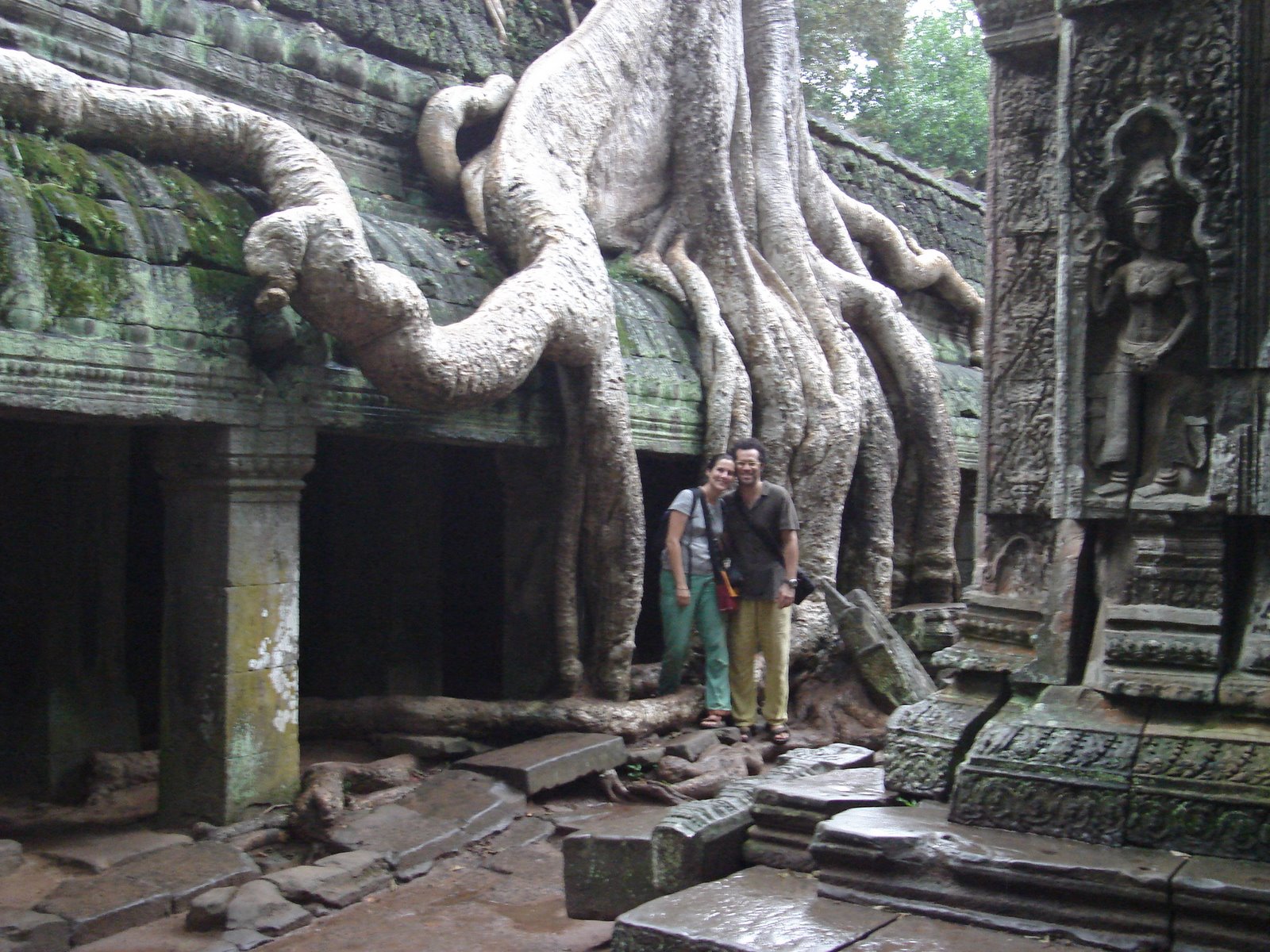
Cerramos el segundo dia visitando el fantastico templo de Ta Prohm, que fue invadido por arboles con raices gigantes como algunos otros templos, pero que en su caso no fueron removidos, y por eso pueden verse imagenes casi irreales como esta en la que ademas estamos nosotros para dar una idea de la proporcion de estos gigantes de la selva. En sus mejores epocas, solo para el mantenimiento y cuidado del templo se necesitaban 80 000 personas, y empleaba 615 bailarinas / Der letzte Besichtigungspunkt und auch Hoehepunkt des Tages war der Tempel von Ta Prohm mit seinen vielen Tuermen. Das besondere an ihm ist wie er vom Dschungel ueberwuchert wurde und die Baeume nicht entfernt wurden. Damals sollen 80 ooo Personen mit der Pflege nur dieses Tempels beschaeftigt gewesen sein und 615 Tempeltaenzerinnen waren angestellt. / Our last visit of the day and also the highlight was the temple of Ta Prohm with its many towers. The very special thing about this temple, is how it had been invaded by the jungle and the trees have not been removed. In former times 80 000 people were busy with taking care of the temple and it employed 615 tempel dancers.


Link al webalbum / link zum Webalbum. Wir machten soviele Fotos, dass wir es nicht auf nur acht beschraenken konnten. Daher kommen hier im Webalbum eine etwas groessere Auswahl / link to the webalbum. As we took so many pictures, we couldn't restrict it to only 8 photos. So you will find a few more in the webalbum:

Sambor Prei Kuk y Angkor